FEIYUEHUI HIGH JEWELRY
Sculptural Imperial Green Jadeite Ring
Glass-Type Natural Jadeite · 18K Gold · Diamonds
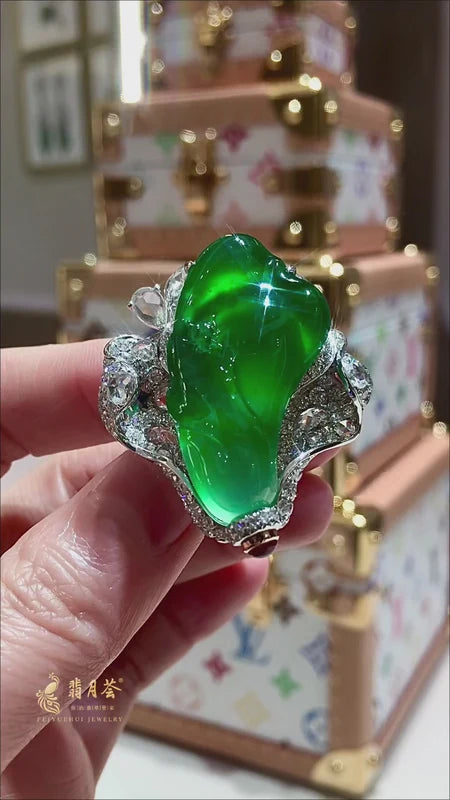
THE OBJECT
The Piece
Carved as a three-dimensional form, this natural jadeite ring is defined by the relationship between material volume, translucency and green.
Rather than presenting color across a flat surface, the carving allows it to move through changing depths of jadeite. Areas of vivid imperial green appear with different intensity as the thickness, curvature and viewing angle change.
The sculptural jadeite is held within an elaborate setting of 18K gold and diamonds. The setting follows the irregular outline of the carving rather than forcing the material into a conventional geometric frame.
What gives the piece its presence is therefore not color alone, but the convergence of translucency, volume, carving, proportion and light.
- Material
- Natural jadeite
- Color
- Imperial green
- Trade description
- Glass-type
- Dimensions
- Jadeite carving: 32 × 17.7 × 6.5 mm; complete ring, including setting: 38.9 × 31.2 × 15.3 mm
- Setting
- 18K gold and diamonds
- Certification
- GUILD gemological certificate available for private review
MATERIAL OBSERVATION
Material Study
Color, Volume and Light
In translucent jadeite, color is experienced through more than hue alone.
Thickness, internal structure, curvature and the path of light through the material can change how green appears from one part of a carving to another. In a three-dimensional form, these relationships become especially visible: thinner passages may transmit light differently from deeper volumes, while curved surfaces continually alter reflection and visual depth.
The term “glass-type” is used in jadeite connoisseurship and the jewelry trade to describe material associated with very fine texture and a high degree of translucency. It should not be read as a standardized laboratory grade.
This piece is also described within Chinese jadeite connoisseurship using the term Longshi (龙石种). Longshi is a traditional collector and trade expression rather than a separate mineral species or internationally standardized gemological grade. Its use here describes a connoisseurship context and should be distinguished from the findings stated on the accompanying gemological report.
Understanding Qi Ying
Another expression used in Chinese jadeite connoisseurship is qi ying (起莹光).
It describes a visual optical effect in which highly translucent, fine-textured jadeite can appear to carry a concentrated inner brightness as light moves across curved or polished surfaces.
In this context, “fluorescence” should not be understood as ultraviolet fluorescence.
Qi ying describes the visible appearance of the jadeite under ordinary viewing light — an interaction of material texture, translucency, curvature and light — rather than a laboratory finding under ultraviolet illumination.
For this reason, the effect is best understood through movement. As the ring turns, changes in angle and surface curvature alter where brightness appears to gather within the carving.
FORM
Carving as Material Architecture
The cabbage motif is treated here as a sculptural form rather than a flat decorative image.
Its folds, raised surfaces and changing depths create variations in thickness across the jadeite. Those variations affect how the material receives, transmits and reflects light.
The carving therefore does more than depict a subject. It establishes the architecture through which the jadeite is seen.
For translucent jadeite, this relationship between carving and material is particularly important. Removing material changes not only form, but also volume, color concentration and optical behaviour.
A successful carving must therefore negotiate two priorities at once: giving the subject definition while preserving the material qualities that made the jadeite worth selecting.
Key Observations
- The three-dimensional carving allows green to move across changing depths of natural jadeite.
- Color, translucency, thickness, curvature and light should be considered together rather than judged independently.
- “Glass-type” is a jadeite trade and connoisseurship description associated with fine texture and high translucency; it is not a standardized laboratory grade.
- Longshi (龙石种) is traditional Chinese jadeite connoisseurship terminology, not a separate mineral species or standardized laboratory grade.
- Qi ying (起莹光) describes a visible optical impression associated with the interaction of fine texture, translucency, curvature and light; it should not be confused with ultraviolet fluorescence.
THE SELECTION
Beyond Color
The immediate attraction of this piece is its green.
Its more demanding qualities emerge through movement.
As the viewing angle changes, the eye encounters differences in thickness, translucency, curvature and color concentration across the carving. The jadeite does not present itself as a uniform plane; its character develops through volume.
This is why sculptural jadeite cannot be assessed by color alone.
Material selection must consider what remains after carving: whether sufficient volume has been preserved, whether the form allows the jadeite to retain its visual depth, and whether the finished setting supports rather than overwhelms the stone.
For Feiyuehui High Jewelry, the carving and setting are therefore judged in relation to the material, not independently from it.
PRIVATE CLIENT SERVICE
Private Viewing
Selected Feiyuehui High Jewelry pieces are available for private consultation and viewing by appointment.