FEIYUEHUI HIGH JEWELRY
Imperial Green Jadeite Cabochon
Ring & Earrings Suite
Glass-Type Imperial Green Jadeite · 18K Gold · Diamonds
THE OBJECT
The Piece
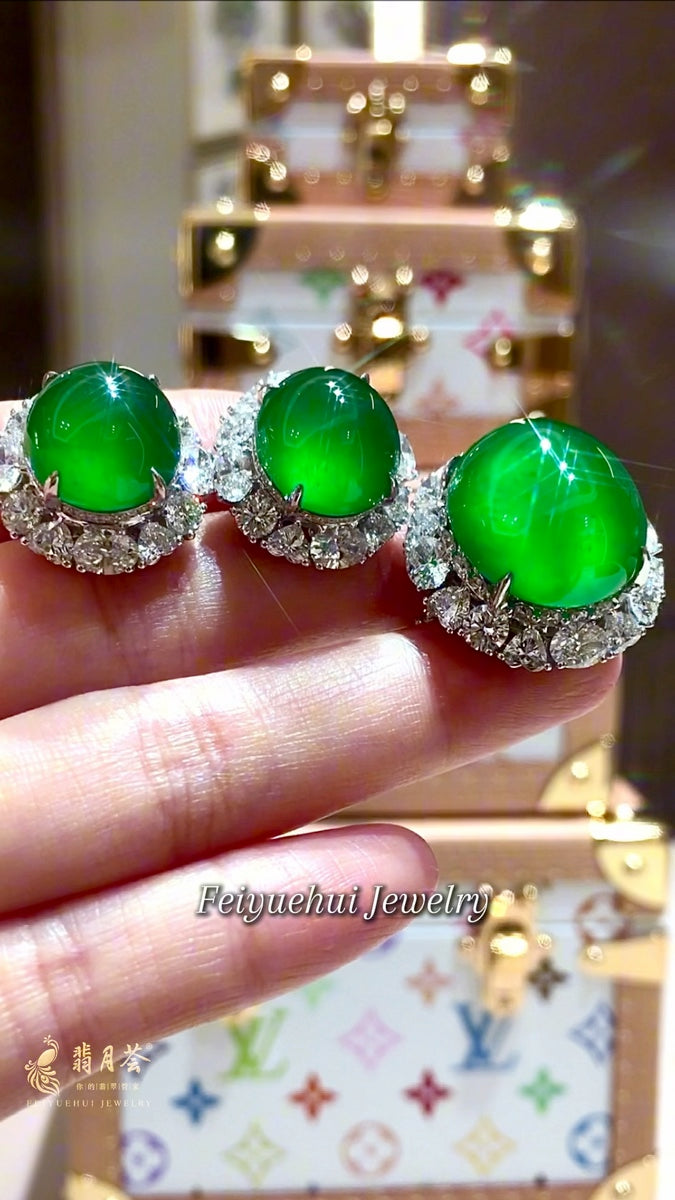
Three imperial green jadeite cabochons form a single High Jewelry suite: one ring and a pair of earrings.
The ring establishes the principal scale of the composition, while the earrings repeat the oval cabochon language at a smaller scale. Their relationship is not based on identical dimensions, but on continuity of material character — green, translucency, texture, rounded volume and proportion.
Each jadeite is framed by diamonds and structured in 18K gold. The contrast is deliberate: broad polished fields of green are set against smaller points of faceted light.
Seen together, the three pieces establish a hierarchy rather than a repetition. The ring acts as the principal focal point; the earrings extend the same material and design language across the face.
Worn separately, each jewel remains complete. Worn together, their shared material character allows them to be read as one composition.
- Material
- Natural jadeite · Glass-type
- Color
- Imperial green
- Translucency
- High translucency
- Jadeite elements
- 3
- Ring jadeite
- 18.5 × 17.0 × 7.5 mm
- Ring — including setting
- 25.0 × 23.3 × 17.7 mm
- Earring jadeite
- 13.5 × 12.5 × 6.3 mm each
- Earrings — including setting
- 19.5 × 18.8 × 14.0 mm each
- Setting
- 18K gold and diamonds
- Certification
- GUILD gemological certificate
MATERIAL OBSERVATION
Material Study
Reading the Jadeite
“Glass-type” is a jadeite trade and connoisseurship description associated with very fine texture and a high degree of translucency. It is not a standardized laboratory grade.
“Imperial green” describes a highly regarded expression of green jadeite, but color alone does not determine the quality of a stone.
Material judgment considers the relationship between color, translucency, texture, thickness, proportion, integrity and surface finish. These qualities affect not only how green appears, but how the material carries visual depth under changing viewing conditions.
In this suite, that judgment must extend across three separate natural jadeites. The objective is not mechanical sameness, but sufficient continuity for the stones to belong to one material family.
The accompanying gemological certificate should be read separately from Feiyuehui’s editorial assessment of material quality.
The Architecture of a Cabochon
A cabochon presents jadeite through a continuous polished surface rather than a pattern of facets.
That distinction places greater emphasis on volume and proportion. Dome height, outline, symmetry, thickness and polish influence how color and translucency are perceived across the stone.
The ring cabochon measures 18.5 × 17.0 × 7.5 mm. Its 7.5 mm thickness contributes materially to its volume and visual presence.
The earring cabochons measure 13.5 × 12.5 × 6.3 mm each. Their smaller scale establishes a different relationship to the face while preserving the rounded material language of the ring.
A cabochon should therefore not be judged by face-up dimensions alone. Thickness and curvature are part of the material architecture.
18K Gold and the Diamond Surround
The 18K gold setting provides the structural framework for the jadeite and diamonds.
Around each cabochon, the diamond surround creates a transition between two different optical behaviours: the continuous polished surface of jadeite and the fragmented reflections of faceted diamonds.
The ring makes this relationship particularly visible. Its elevated cabochon, diamond surround and shank must resolve as one structure rather than as separate decorative components.
Viewed from the side, the depth of the setting becomes part of the design. The mount determines how the jadeite is held, how its volume is presented and how the surrounding diamonds relate to the central stone.
Here, setting is not an addition to the material.
It is the architecture that allows the material to be seen.
MATCHING RARITY
Why Matching Matters
A three-piece suite introduces a different matching problem from a single jewel.
The earrings require bilateral balance. Their jadeite cabochons must relate closely enough in color, translucency, texture, outline, thickness and scale to be read naturally as a pair.
The ring performs a different role.
It does not need to duplicate the earrings. Its larger cabochon establishes hierarchy, giving the suite a principal focal point while remaining within the same material and visual family.
This distinction is important.
Matching rarity does not require natural stones to become mechanically identical. It requires variation to remain controlled enough that no element weakens the coherence of the whole.
The three cabochons therefore operate at two levels: the earrings as a closely related pair, and the ring as a larger expression of the same material language.
That relationship — pair, hierarchy and continuity — is what allows three independently formed natural jadeites to become one suite.
THE SELECTION
One Material Language
Selecting jadeite for a suite requires a different discipline from selecting one exceptional stone.
The question is no longer only whether each cabochon succeeds individually.
It is whether several natural stones can sustain one standard when placed in direct relationship.
For the earrings, this means maintaining visual balance across a pair.
For the ring, it means increasing scale without allowing the material character to separate from the earrings.
Color, translucency, texture, thickness, proportion and integrity must therefore be considered both stone by stone and across the complete suite.
Source determines where the search begins.
Judgment determines what belongs together.
COLLECTOR’S NOTE
Reading the Suite
The first impression is imperial green.
The more revealing judgment begins after that first impression.
Viewed closely, the suite asks the eye to move between three relationships: the volume of each cabochon, the transition from jadeite to diamond, and the change of scale from earrings to ring.
The earrings establish symmetry across the face. The ring introduces greater volume and a stronger focal point. Their connection comes from material continuity rather than identical size.
This is why a suite should not be assessed as three isolated objects.
Its quality also lies in the relationships between them.
For Feiyuehui High Jewelry, the final consideration is therefore not simply whether each jadeite is fine, but whether three natural stones, three settings and two different scales can sustain one coherent material language.
PRIVATE CLIENT SERVICE
Private Viewing
Selected Feiyuehui High Jewelry pieces are available for private consultation and viewing by appointment.