A STUDY IN GREEN
PROPORTION AND LIGHT
Five Imperial Green Jadeite
Cabochon Necklace
Five Glass-Type Imperial Green Jadeite Cabochons · 18K Gold · Diamonds
REFERENCE · FYH-A5304
ORIGIN · Myanmar (Burma)
CERTIFICATION · GUILD
CATEGORY · High Jewelry
The Piece
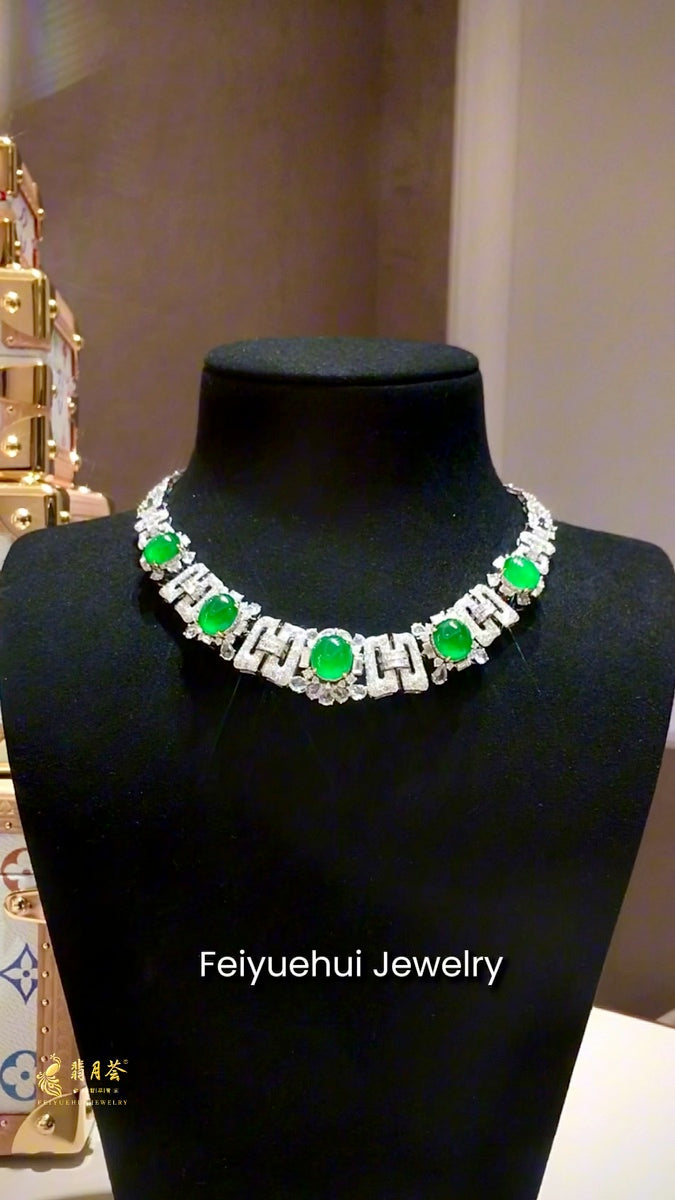
Five imperial green jadeite cabochons form the material centre of this High Jewelry necklace.
Their presence depends not on color alone, but on the relationship between saturated green, translucency, texture, cabochon volume and proportion. Set across the neckline, the five natural stones must be read both individually and as one composition.
The rounded jadeite surfaces are placed against an articulated structure of 18K gold and diamonds. Geometric diamond-set links introduce a sharper rhythm of light, while the cabochons retain broad, uninterrupted fields of green.
The composition therefore moves between two visual languages: the depth and continuity of polished jadeite, and the more fragmented brilliance of faceted diamonds.
What holds the necklace together is not repetition alone, but proportion — the relationship between five natural stones, their settings, the spaces between them and the way the entire work moves when worn.
- Jadeite
- Natural jadeite · Glass-type · Imperial green · 5 cabochons
- Setting
- 18K gold and diamonds
- Largest jadeite
- 12.5 × 11.0 × 5.0 mm
- Smallest jadeite
- 11.3 × 10.6 × 4.3 mm
- Necklace length
- 16 inches / 40.64 cm
- Origin
- Myanmar (Burma)
- Certificate
- GUILD gemological certificate
- Reference
- FYH-A5304
Material Study
Understanding Glass-Type Imperial Green
In jadeite connoisseurship, “glass-type” describes material associated with exceptionally fine texture and a high degree of translucency. It is a trade and connoisseurship description rather than a standardized laboratory grade.
“Imperial green” is likewise a descriptive term used for the most highly regarded expressions of green jadeite. Color alone, however, does not determine the quality of a stone.
In fine jadeite, color is read together with translucency, texture, thickness, proportion, integrity and the way light moves through and returns from the material.
This relationship matters particularly in a multi-stone jewel. Five cabochons may share a green family while differing subtly in saturation, translucency, depth or volume. The challenge is not to erase natural variation, but to select stones whose differences remain coherent when seen together.
This is why material identity is only the beginning of judgment.
Why the Cabochon Matters
A cabochon replaces facets with a continuous polished surface. In jadeite, that distinction is important.
Rather than breaking reflected light into numerous faceted flashes, the curved surface allows color, translucency and internal visual depth to be read across a broader field.
Its apparent simplicity makes proportion more consequential.
Dome height, thickness, outline, symmetry and polish influence how the stone carries color and how light behaves within the material. A cabochon that is too shallow may lose volume; one whose proportions are poorly resolved may alter the balance between color, translucency and presence.
For this necklace, the largest cabochon measures 12.5 × 11.0 × 5.0 mm and the smallest 11.3 × 10.6 × 4.3 mm.
The dimensions matter not simply as scale, but because thickness and volume remain part of how each jadeite performs visually.
18K Gold, Diamonds and Structure
Here, 18K gold provides the architecture for an elaborate diamond-set composition.
The necklace alternates smooth oval jadeite cabochons with geometric diamond-set links. Around each jadeite, diamonds articulate the transition between the broad surface of the cabochon and the finer rhythm of the surrounding structure.
The contrast is deliberate.
Jadeite presents color and depth through a continuous polished surface; diamonds introduce sharper points of reflected light. Neither material needs to imitate the other.
For a necklace of this complexity, the setting must also function in motion. Links, spacing, stone security and articulation determine how the work follows the neckline and how its visual rhythm is maintained when worn.
In High Jewelry, structure is not separate from appearance. It is one of the conditions that allows the composition to exist.
Matching Rarity
Why Five Matter
The rarity of a five-cabochon necklace cannot be understood by assessing one stone at a time.
Each jadeite remains naturally individual. Yet across the group, color, translucency, texture, dome height, outline, thickness, volume and proportion must sustain a coherent visual standard.
Matching does not mean mechanical sameness.
Natural variation can remain visible while the group still feels balanced. What matters is that no single stone weakens the material language of the whole.
Measurements establish scale, but they cannot fully describe a successful match. Two cabochons with similar dimensions may still differ visibly in saturation, translucency, texture or the way they hold light.
Matching rarity begins when several independently formed natural stones can be brought together without requiring the quality of the composition to be compromised.
In this necklace, five jadeites must succeed twice: first as individual stones, and then as one work.
The Selection
One Standard, Five Stones
A multi-stone jadeite jewel introduces a form of rarity that extends beyond the quality of any single cabochon.
Source determines where the search begins.
Judgment determines what is ultimately selected.
For Feiyuehui, the presence of five green jadeites is not sufficient. Each stone must contribute to the whole through material quality, translucency, color, texture, proportion and integrity.
The difficulty increases with every additional element. Consistency must be sustained without erasing the individuality inherent in natural jadeite.
The final rarity therefore lies in convergence: five naturally distinct materials capable of sustaining one visual and material standard.
180 Days in the Making
The setting was completed over a period of approximately 180 days.
The significance of that period is not a conversion into labour hours, but the sequence of decisions required by a complex articulated jewel.
Fitting, assembly, stone setting, finishing and final adjustment occur in stages. Across those stages, the necklace must resolve several relationships at once: the security of five jadeite cabochons, their diamond surrounds, the articulation of the geometric links, the spacing between elements and the way the entire composition settles against the neckline.
A change to one relationship can affect another.
The finished work therefore depends not only on the quality of its materials, but on the discipline with which those materials are brought into proportion, movement and balance.
Collector’s Note
Material, Proportion, Movement
The significance of this necklace lies in convergence.
Five imperial green jadeite cabochons bring together color, translucency, texture and volume; their settings introduce structure, articulation and a contrasting rhythm of diamond light.
No single quality explains the work.
Its presence emerges from the relationship between material rarity, matching rarity, proportion, craftsmanship and movement.
For Feiyuehui High Jewelry, this is the distinction between assembling several fine stones and creating a coherent jewel: each element must retain its individual quality while contributing to a whole that is stronger than any isolated component.
The five jadeites remain the centre of the composition.
The setting exists to give their relationship form.
The Necklace in Motion
PRIVATE CLIENT SERVICE
Private Viewing
Available for private consultation and viewing by appointment.