FEIYUEHUI HIGH JEWELRY
Glass-Type Yang Green Jadeite Geometric Suite
11 Three-Dimensional Jadeite Forms · 18K Gold · Diamonds
THE OBJECT
The Piece
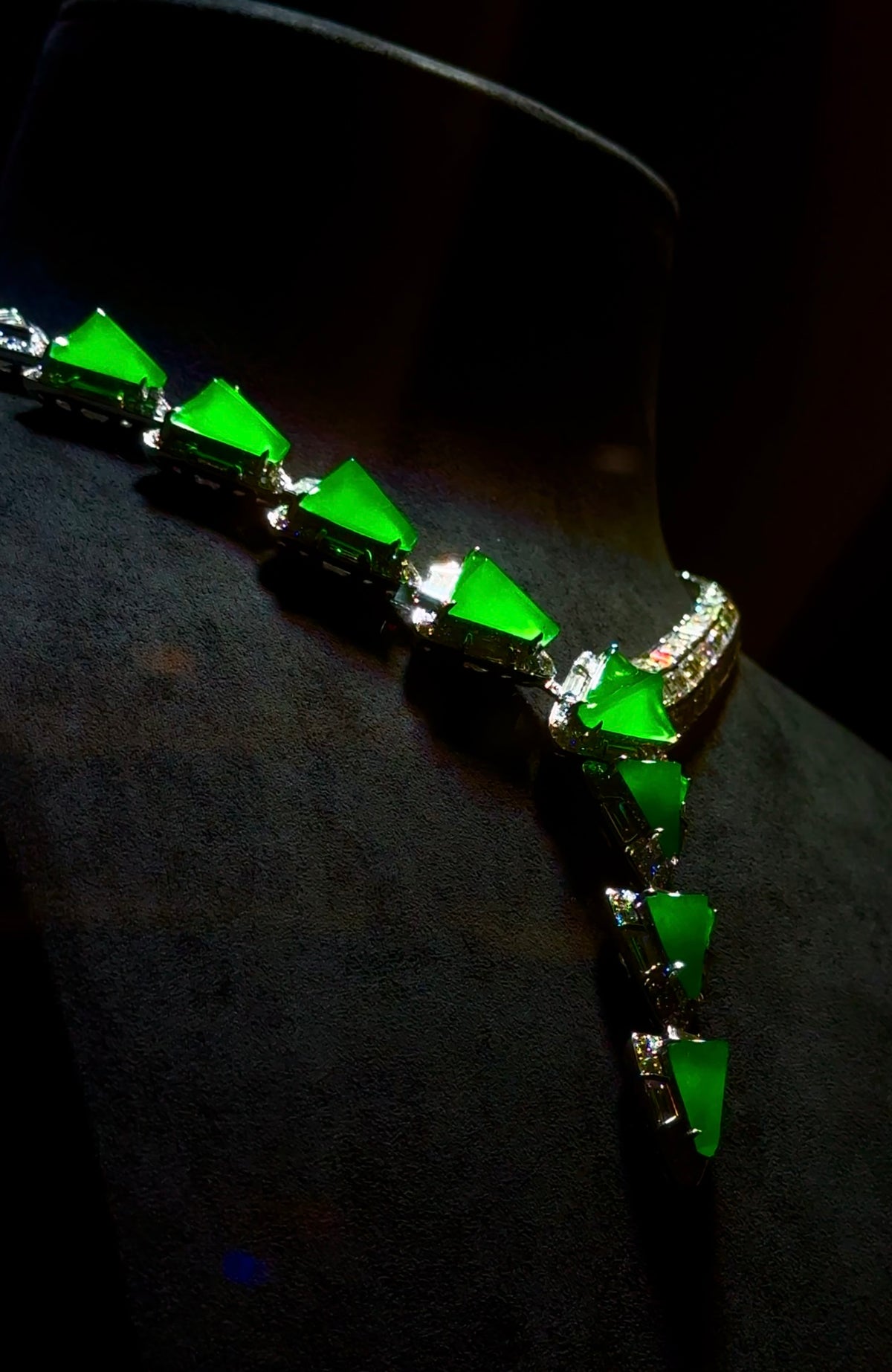
Eleven glass-type Yang green jadeite forms define this High Jewelry suite — eight composing the necklace, two forming the pair of earrings, and one set into the ring.
Rather than relying on familiar jadeite motifs or conventional cabochon forms, each jadeite element is shaped as a three-dimensional triangle. The geometry introduces volume, edges and directional planes into a material more often associated with rounded or traditionally carved forms.
Across the necklace, earrings and ring, the design depends not on repetition alone, but on maintaining a coherent relationship between color, translucency, scale, proportion and three-dimensional form.
This suite brings together eleven glass-type Yang green jadeite elements across a necklace, a ring and a pair of earrings.
Eight three-dimensional triangular jadeite forms compose the necklace, which measures 41 cm in total length. The largest necklace jadeite measures 12.6 × 12.6 × 5.2 mm, while the smallest measures 11.8 × 9.2 × 4.8 mm.
The earrings each feature a jadeite element measuring 12.2 × 8.6 × 6.6 mm. The ring is centred on a jadeite element measuring 12.0 × 12.2 × 7.1 mm.
18K gold and diamonds articulate the spaces between the jadeite forms, introducing reflected light while preserving the geometric identity of the jadeite as the central visual language of the suite.
- Material
- Natural Glass-Type Jadeite
- Color
- Yang Green
- Dimensions
- Necklace: 41 cm; largest jadeite 12.6 × 12.6 × 5.2 mm; smallest jadeite 11.8 × 9.2 × 4.8 mm. Earrings: 12.2 × 8.6 × 6.6 mm each. Ring: 12.0 × 12.2 × 7.1 mm.
- Jadeite elements
- 11
- Setting
- 18K Gold & Diamonds
MATERIAL OBSERVATION
Material Study
Beyond the Conventional Jadeite Form
Jadeite jewelry is often associated with established forms: cabochons, beads, bangles and carved motifs whose visual language has developed over generations.
This suite takes a different approach.
Its jadeite elements are shaped as three-dimensional triangular forms, introducing planes, edges and directional geometry into the material. The result is not simply a change of outline. A three-dimensional form changes how volume is distributed, how individual surfaces meet the light, and how the eye moves from one jadeite element to the next.
For jadeite, this matters because form and material cannot be separated. A design must work with the stone’s translucency, thickness, internal structure and usable volume rather than treating jadeite as an interchangeable material.
The geometry therefore becomes part of the material study itself.
Form, Volume & Light
Three-dimensional geometry changes the way jadeite interacts with light.
Unlike a conventional rounded cabochon, a triangular form introduces multiple planes and transitions. As the viewing angle changes, each surface can present the material differently, making proportion and thickness integral to the visual result.
The necklace elements range from 12.6 × 12.6 × 5.2 mm at the largest to 11.8 × 9.2 × 4.8 mm at the smallest. The earrings measure 12.2 × 8.6 × 6.6 mm, while the ring jadeite measures 12.0 × 12.2 × 7.1 mm.
These measurements matter not simply as specifications, but because volume determines how the geometric concept exists in three dimensions.
The diamonds perform a separate role: they introduce reflected light and articulate the intervals between jadeite elements without replacing the material presence of the jadeite itself.
Understanding Yang Green
In Chinese jadeite terminology, Yang green describes a bright, lively green with a fresh visual character.
Color terminology alone, however, does not determine jadeite quality.
In High Jewelry, green must be considered together with translucency, texture, thickness, proportion and the way the material responds under different viewing conditions.
Within a multi-piece suite, color must also remain sufficiently coherent from one jadeite element to another. This relationship between color and material consistency becomes increasingly demanding as the number of stones increases.
For this reason, the Yang green color of the suite is considered as one part of a broader material assessment rather than as an isolated grade.
A Different Jadeite Vocabulary
Jadeite carries a long visual tradition, but tradition does not require repetition.
The three-dimensional triangular forms in this suite move away from familiar symbolic motifs and conventional rounded profiles, allowing jadeite to be read through geometry, proportion and material presence.
The design remains recognizably centred on jadeite, yet its language is contemporary.
This distinction matters to Feiyuehui: innovation in jadeite should not come from disguising the material, but from finding new ways for its natural qualities to remain visible.
MATCHING RARITY
Why Matching Matters
Matching eleven natural jadeite elements is a different challenge from selecting a single exceptional stone.
Consistency does not mean that every element must be mechanically identical. It means that no individual jadeite should weaken the visual standard of the whole.
Across this suite, the eye reads several qualities simultaneously: Yang green color, translucency, material texture, thickness, scale, proportion and the relationship between the three-dimensional triangular forms.
This becomes more demanding when the same material language must continue across three different types of jewelry — necklace, earrings and ring.
The necklace alone requires eight jadeite elements to function as one composition. The earrings introduce bilateral balance, while the ring must remain visually related to the suite despite being read as a single central form.
Matching rarity therefore lies not simply in finding similar stones, but in sustaining material coherence across multiple independently formed pieces of natural jadeite.
THE SELECTION
Collector’s Note
What distinguishes this suite is not a single jadeite element in isolation, but the difficulty of sustaining one material and design language across eleven natural jadeite forms.
Glass-type texture, Yang green color, translucency, three-dimensional geometry, proportion and matching must remain coherent across a necklace, a pair of earrings and a ring.
Its rarity lies in convergence: an unconventional form, repeated across multiple natural jadeite elements without allowing the whole to lose material consistency.
For Feiyuehui High Jewelry, this is where design and selection become inseparable.
FEIYUEHUI STUDIOS
Related Study
PRIVATE CLIENT SERVICE
Private Viewing
Available for private consultation and viewing by appointment.